You want information for
Enhanced Crack Ruler
If you would like a quotation or have any questions about the product, please contact us:
- by email at info@saugnac-gauges.com
- by telephone on +33 9 62 07 18 68



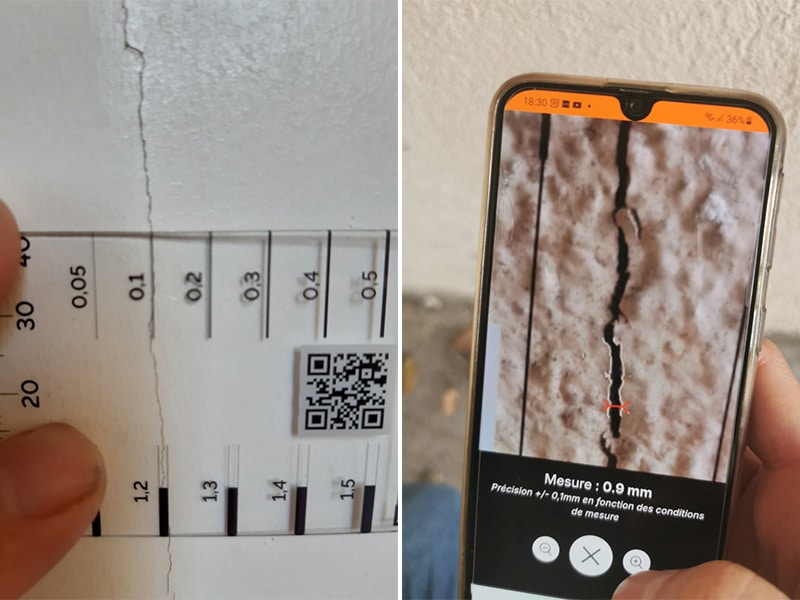

Overview of the enhanced crack rulerThe Saugnac “enhanced” crack ruler is a transparent crack width gauge for measuring the width of a crack in a wall, a facade, a slab or a concrete structure. It measures crack width in two ways:
For automatic reading, the app uses the graduations on the ruler as a reference: it detects the edges of the crack and calculates its width at the point you select. The reading depends less on the operator’s visual judgement, and the result can be saved as an annotated photo. The crack ruler is used to record a crack at a given moment. To find out whether the crack is moving, a crack monitor must be fixed on either side of it (see below). | |
One-off measurement or monitoring: what you need to know
| |
When to use itCrack width is the first value recorded on a crack. The enhanced crack ruler is used in particular for:
For site work, the crack ruler is also available in the Expert’s set (with 3 G1 gauges) and the Expert’s set Plus (with 3 G1+ gauges). | |
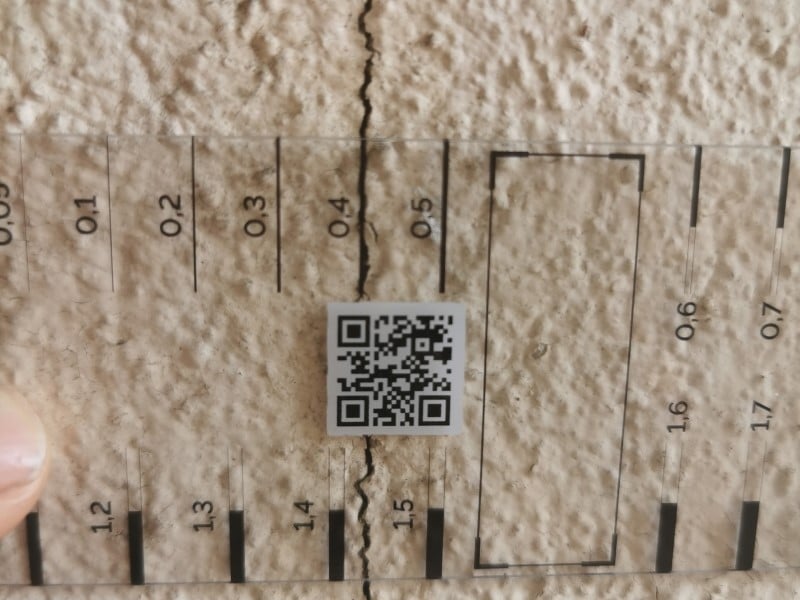
Visual reading: crack under 2 mmThe crack ruler has 22 graduated lines from 0.05 mm to 2 mm. Place it on the crack and slide it until the thickness of a graduated line exactly matches the width of the crack. The value of that line gives the crack width.
In the examples above, the readings are 0.1 mm, 0.4 mm and 1.5 mm respectively. | |
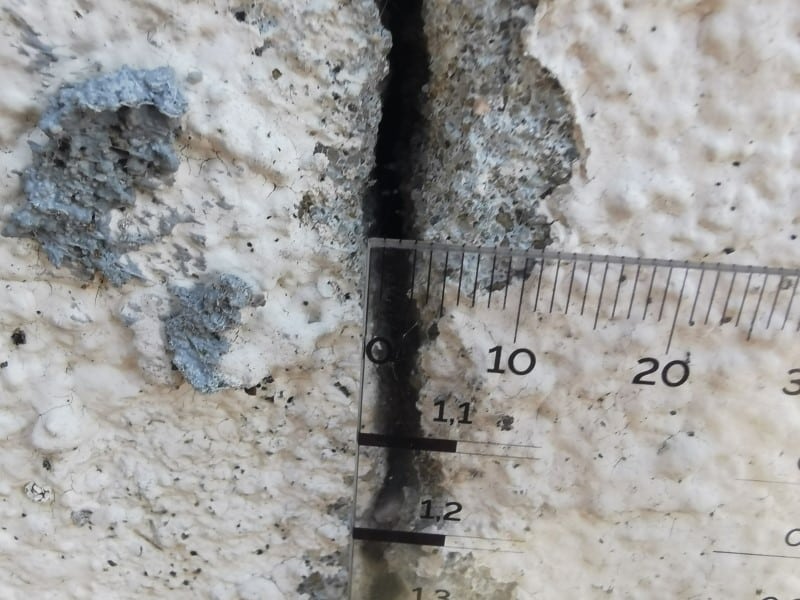
Visual reading: crack over 2 mm
In the example opposite, the reading is 3 mm. For a crack in an internal corner, or to measure a gap between two elements, the stainless steel triangular gauge, which is inserted into the opening, is a practical complement. | |
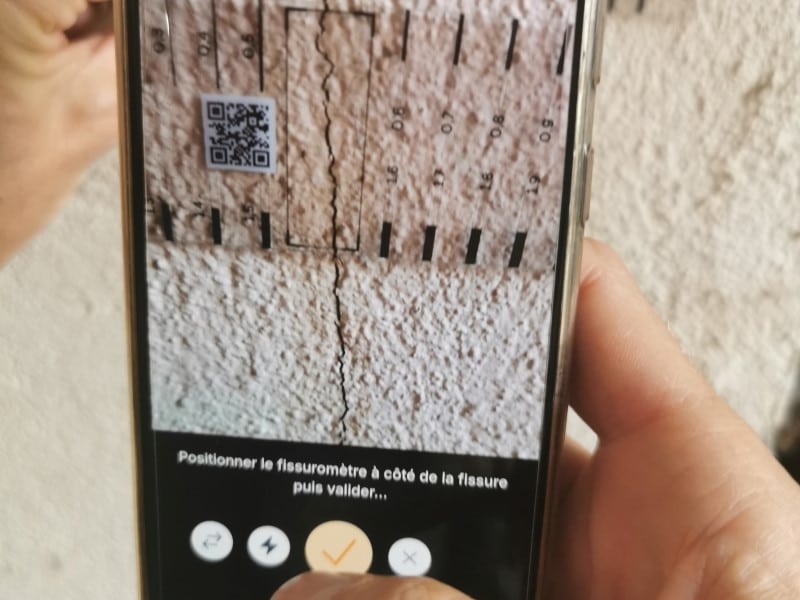
Augmented reality reading with the Saugnac appAccessing the app and positioning the crack rulerThe augmented reality reading function is available without installation from https://saugnac.app, by tapping “Measure using the crack ruler“, or directly by scanning the QR code on the crack ruler. If you prefer, you can also install the Saugnac app on your phone. Then position the crack ruler so that the part of the crack to be measured is visible in its reading frame. For the analysis to work, the following must be visible: the QR code, the 4 graduated lines above and below the frame, and the two lines on the right.
1 – Starting the analysisOnce the crack ruler is in position, start the analysis by tapping the button. 2 – Detecting the crack rulerThe app analyses the image to detect the crack ruler. If detection is difficult:
The analysis requires a recent phone with a good-quality camera and a sufficiently powerful processor. 3 – Selecting the area to measureOnce the crack ruler has been detected, tap the part of the crack you want to measure on the screen. 4 – Calculating and displaying the resultThe app calculates and displays the crack width. The zoom button Automatic reading is an aid to estimation: depending on the quality and position of the camera and on the lighting, the value given may vary by ± 0.1 mm. 5 – Saving the photoThe photo, showing the detected edges and the calculated width, can be saved to your phone. It is not kept in the app, so file it with your records (see one-off measurement or monitoring). | |
Frequently asked questionsWhat is the difference between a crack ruler and a crack monitor?A crack ruler measures the width of a crack at a given moment: it is placed on the crack for the reading and then removed. A crack monitor (or tell-tale) is fixed on either side of the crack and measures its movement from one reading to the next, for example the G1+ gauge. Can the app be used to monitor how a crack develops?No. With the crack ruler, the app calculates the width and lets you save the annotated photo to your phone, but it does not keep a history or plot any trend. Monitoring over time is done with crack monitors, whose readings are centralised in the Saugnac app. Do I need to install an app?No, it is not required. Augmented reality reading works directly in your smartphone’s browser, at saugnac.app or by scanning the QR code on the crack ruler. If you wish, you can also install the Saugnac app on your phone. What crack widths can be measured?From 0.05 mm to 40 mm by visual reading: with the 22 graduated lines from 0.05 mm to 2 mm, then with the millimetre scale up to 40 mm. How are cracks classified by width?In the UK, BRE Digest 251 (Assessment of damage in low-rise buildings) classifies damage into categories 0 to 5, based mainly on crack width; categories 0 to 2 cover cracks up to 5 mm. With a reading range of 0.05 to 40 mm, the crack ruler measures widths from hairline cracks to wide cracks. Crack width alone does not show whether a crack is active: only monitoring over time shows whether it is moving. How do I measure a crack in a corner?As the crack ruler is flat, it is suited to cracks on flat surfaces. For a crack in a corner, or to measure a gap between two elements, use the triangular gauge. How accurate is automatic reading?Depending on the quality and position of the camera and on the lighting, the width estimated by the app may vary by ± 0.1 mm. What phone do I need for automatic reading?A recent smartphone with a good-quality camera and a sufficiently powerful processor. If detection fails, check that the app is not using the wide-angle camera. |

Expert’s set including : 1 enhanced crack ruler, 3 G1 crack monitors, installation instructions, a marking pen.

Expert’s set Plus including : 1 enhanced crack ruler, 3 G1+ crackmonitors (with “digital” reading), installation instructions, a marking pen.