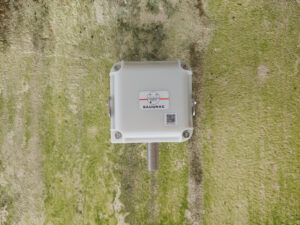
Saugnac Gauges designs and manufactures wireless sensors for structural health monitoring (SHM): crackmeters, tiltmeters and displacement sensors for the remote monitoring of buildings and civil engineering structures. Our instruments track the evolution of cracks, tilt, settlement and deformation, with data available from the Saugnac app — no site visit required.
Remote structural monitoring: principle and benefits
Monitoring structural disorders (cracks, tilting, settlement, deformation) has traditionally relied on regular site inspections: the expert takes manual measurements, photographs the area and records how the disorder evolves. This method is reliable but costly and time-consuming, especially on remote or hard-to-reach structures.
Wireless instrumentation makes it possible to collect measurements automatically and track the evolution of a disorder remotely. Readings taken at programmed intervals provide an objective record of how a structure behaves over time — a valuable resource for engineering consultancies, surveyors, building experts and asset managers.
Monitoring cracks, tilt, settlement and deformation
Our range of wireless sensors covers the full spectrum of disorders found on buildings and civil engineering works:
- Remote crack monitoring: the R1 and R2 wireless crackmeters automatically measure crack opening and transmit the readings to the app. The R2, with its cabled external sensor, covers large displacement amplitudes (up to 100 mm).
- Tilt and overturning monitoring: the R5 wireless tiltmeter, or surface inclinometer, measures the tilt of a wall, gable or structure on two axes, with a resolution of 0.005°.
- Settlement monitoring: the R2.P wireless settlement monitor tracks the settlement of bridge bearings and structures while absorbing the longitudinal movement caused by deck expansion.
- Deflection and bending monitoring: the R130 gauge measures the deformation of a beam or load-bearing element remotely.
- Wall spacing monitoring: the R20 wireless extensometer tracks the distance between two points several metres apart.
- Temperature and humidity monitoring: the R10 wireless sensor records ambient conditions, on their own or alongside a structural measurement.
- Min/max recording: the mechanical G2 gauge records the minimum and maximum variation of a crack on a graduated scale, a simple and economical option.
Automatic recording of measurements
The wireless sensors can be set to transmit data every 1h, 2h, 4h, 6h, 8h, 12h or 24h. At each cycle, the device wakes up, takes its measurements using its internal sensors, then transmits the results to the dedicated app. Battery life can reach up to 8 years depending on the reading frequency. For sensitive phases requiring closer observation, the Monitoring+ mode allows the evolution of a disorder to be followed more finely.
Monitoring hard-to-reach areas
Disorders are not limited to visible areas: high façades, viaducts, bridges, water towers and building vaults are often affected. Each manual measurement there requires heavy logistics (rope-access technicians, cradles, scaffolding). Once installed, wireless sensors transmit their readings remotely and significantly reduce these costs and risks. Find out more about monitoring cracks on inaccessible façades and the monitoring of hydraulic structures.
With Saugnac Gauges, remote structural monitoring becomes a complete solution for buildings and civil engineering works: reliable instrumentation, long battery life and simple access to data to support the safety and durability of your structures.
Frequently asked questions about remote monitoring
How do you monitor a crack remotely?
A wireless crackmeter is fixed on either side of the crack. It automatically measures the opening at programmed intervals and transmits the readings to the Saugnac app, viewable from a computer, tablet or smartphone, with no site visit required.
How often do the wireless sensors transmit measurements?
The sensors can be set to transmit data every 1h, 2h, 4h, 6h, 8h, 12h or 24h. At each cycle, the device wakes up, takes its readings using its internal sensors, then transmits the results to the app.
What is the battery life of Saugnac wireless sensors?
Battery life can reach up to 8 years depending on the reading frequency configured. A longer transmission interval extends the battery life.
Which disorders can be monitored with Saugnac wireless sensors?
The range covers the monitoring of cracks, tilt and overturning, settlement, deflection and deformation, as well as wall spacing and ambient conditions, on both buildings and civil engineering structures.
Can these sensors be installed on hard-to-reach structures?
Yes. Once installed, the sensors transmit their readings remotely, which avoids repeated interventions on hard-to-reach areas such as high façades, bridges, viaducts or building vaults.