R2.P Gauge – Settlement monitoring of bridges and engineering structures

784,00 w/o VAT

  • Autonomous connected gauge for settlement monitoring of structures subject to thermal variations
  • Absorption of longitudinal variations caused by thermal expansion
  • Measures the evolution of vertical displacements (settlement)
  • Includes 3 sensors: Linear displacement – 0.01 mm resolution, Temperature – 0.1°C resolution, Relative humidity – 1% RH resolution
  • 1-year subscription included for automatic data transmission (annual renewal: €49 excl. VAT).
  • Management of a Monitoring+ mode
  • Up to 8 years of battery life

Made in France Made in France

R2.P Gauge – for monitoring bridges and structures subject to thermal variations

The R2.P gauge is a connected sensor specially adapted to the monitoring of structures subject to combined movements of longitudinal thermal variations and vertical settlement.

Developed to meet the specific constraints of bridges, this variant of the R2 gauge incorporates a mechanical system that absorbs the variations in length caused by the expansion of the deck. It thus enables reliable monitoring of bearings, abutments, decks and critical areas of engineering structures.

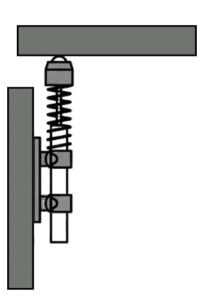
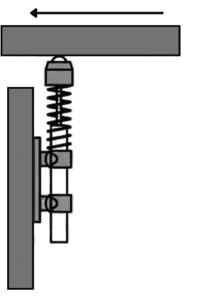
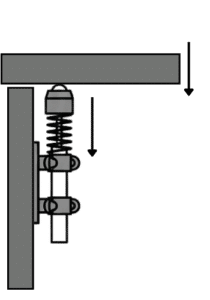
R2.P gauge mounting diagram on a bridge structure - step 1 R2.P gauge mounting diagram on a bridge structure - step 2R2.P gauge mounting diagram on a bridge structure - step 3

How it works

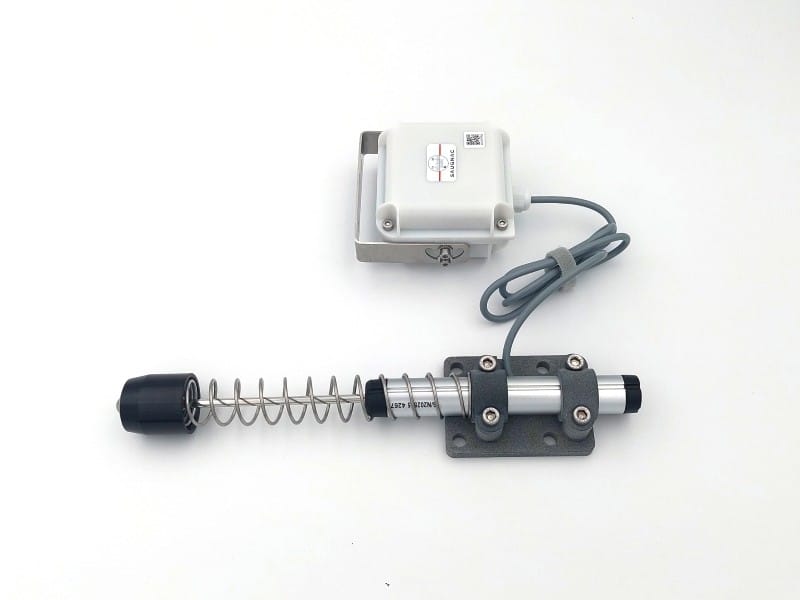
The R2.P integrates an optimised mechanical assembly ensuring constant contact, controlled freedom of movement and measurement accuracy all at once:

  • a connected R2 gauge (100 mm range),
  • a spring system sized to maintain constant contact,
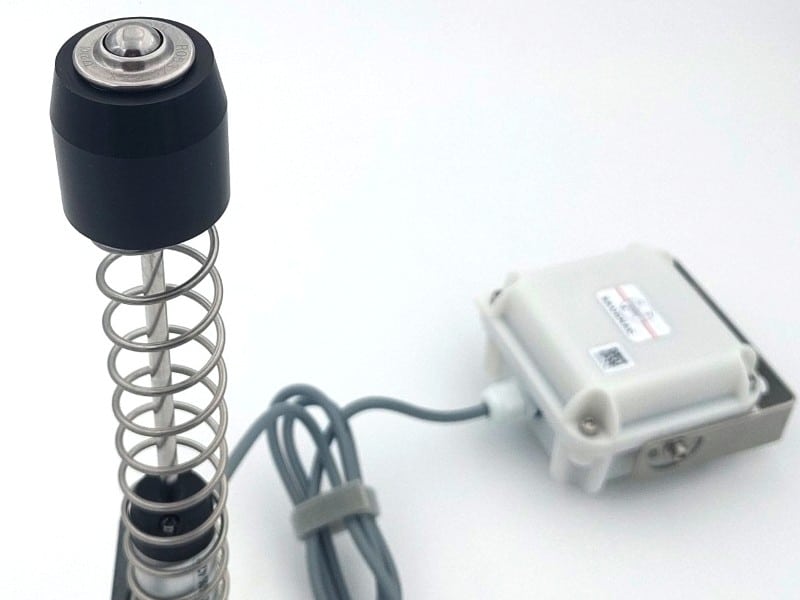
  • a head fitted with a load-bearing ball providing omnidirectional sliding,
  • a dedicated part allowing secure mechanical integration.

Thanks to this specific design, the system enables:

✅ the absorption of longitudinal variations caused by thermal expansion

✅ the accurate measurement of vertical displacements (settlement),

✅ stable operation even when the direction of movement changes.

Technical specifications

  • Linear sensor
    Resolution: 0.01 mm, Measurement range: ~100 mm, Accuracy: ±0.1% FS
  • Temperature sensor
    Resolution: 0.1°C, Measurement range: −40°C to 125°C, Accuracy: ±0.2°C
  • Humidity sensor
    Resolution: 1% RH, Measurement range: 0–100% RH, Accuracy: ±2% RH
  • Measurement frequency
    Standard mode: 1h, 2h, 4h, 6h, 8h, 12h, 24h
    “Monitoring+” mode (time-limited): every 2, 5, 10, 20 or 30 min
  • Data transmission frequency
    Standard mode: twice a day, daily, every 2 days, every 3 days, weekly
    “Monitoring+” mode: every 1h, 2h, 3h or 4h
  • Battery life
    Between 2 and 8 years depending on measurement and transmission settings
  • Operating temperature
    From −30°C to +70°C
  • Network coverage
    LTE-M / NB-IoT multi-operator communication module. Works in basements / underground areas / parking facilities.
  • Mounting
    Mounting on solid or hollow substrates using the supplied hardware. Angled mounting possible with the mounting kit.
  • Dimensions
    Housing: 84 × 84 × 56 mm – Sensor (retracted): 250 mm × Ø20 mm
  • Ingress protection
    Housing: IP66, Sensor: IP65
  • Weight
    350 g including the battery
  • Warranty
    2 years

Key points

Like the R2 gauge from which it derives, it measures displacements of up to 100 mm, thanks to a large-range external linear sensor.

It retains all the electronic and connectivity features of the R2: multi-operator communication over the LTE-M and NB-IoT networks, integrated temperature and humidity sensors enabling measured changes to be correlated with ambient conditions, as well as an enhanced monitoring mode that can be activated remotely.

Its battery life can reach up to 8 years, depending on the chosen configuration, and a one-year subscription to data transmission is included on commissioning. All data remains accessible via the Saugnac web and mobile application, available free of charge.

Remote monitoring

All recorded data — displacement, temperature and humidity — is accessible in real time via the Saugnac application, on both computer and smartphone.

The interface makes it possible to view the measurements as customisable graphs, to export the data in Excel or CSV format for further analysis, or to generate a shareable link to a dynamic report that is always up to date.

A configurable alert system can be activated so as to be informed automatically whenever a defined threshold is exceeded. Even after the transmission subscription expires, the measurement history remains available in the application.

“Monitoring+” mode: enhanced monitoring activated remotely

During an exceptional event — nearby works, an impact, abnormal movement or a structural alert — the gauge can be switched remotely to Monitoring+ mode.

This mode temporarily increases the frequency of measurements and transmissions in order to obtain close, responsive monitoring. Measurement frequencies can be set between 2 and 30 minutes, while data transmission can be configured between 1 and 4 hours.

The maximum duration of use of the mode depends on the selected frequency (for example 4 days at 2 minutes, up to 60 days at 30 minutes). At the end of this period, the system automatically returns to standard mode to preserve battery life. Monitoring+ can be reactivated several times, up to a limit of 12,000 measurements.

Measurement frequencyMax. duration
2 min4 days
5 min10 days
10 min20 days
20 min40 days
30 min60 days

Installing the R2.P gauge

Registering and configuring the R2.P is carried out in exactly the same way as for the R2 gauge, via the Saugnac application (see the R2 product sheet for the full step-by-step procedure).

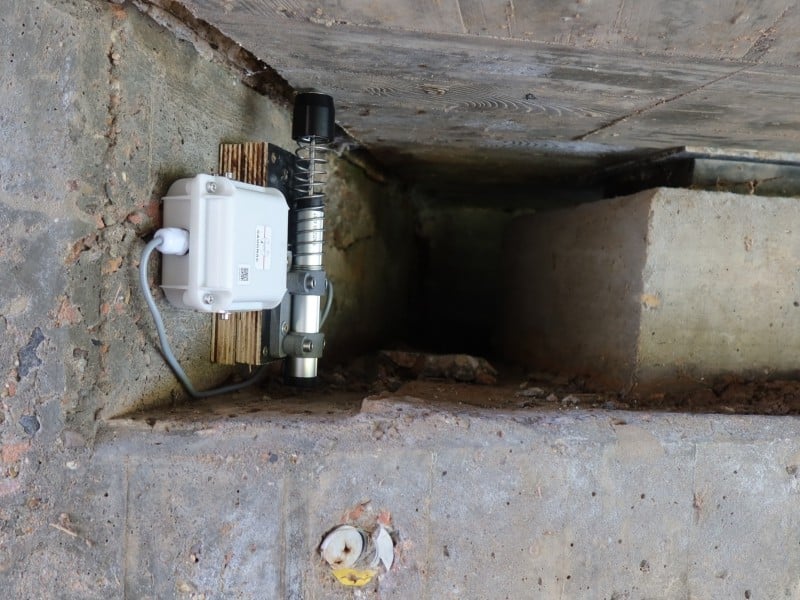
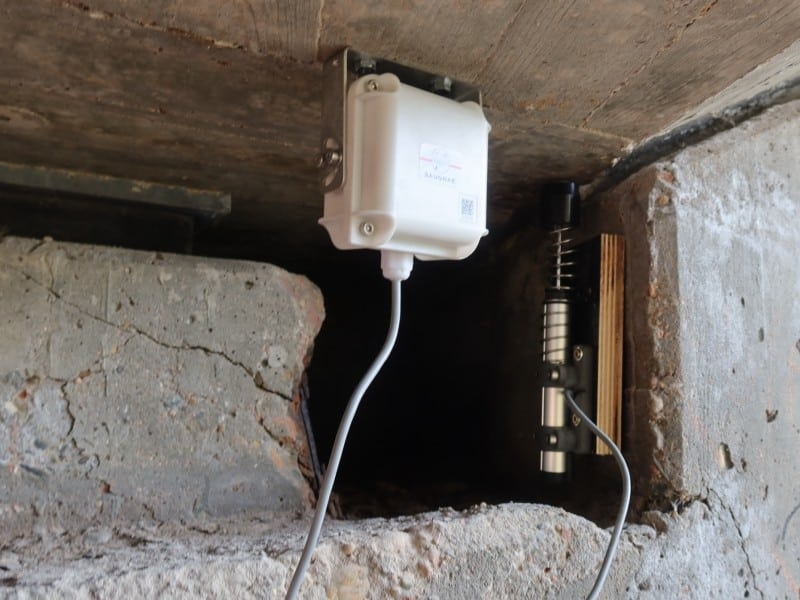
The specific feature of the R2.P lies in its mechanical implementation. Installation consists in fixing the support onto the structure, then positioning the gauge by compressing the spring by about 5 cm during assembly. This pre-compression provides a measurement range of about ± 5 cm around the initial position.

The compression value can be adjusted according to the estimated movement and the monitoring context, in order to optimise the useful measurement range.

Related Products