G130 Gauge – Deflection and wall tilting

  • Custom device to monitor, to within 0.2 mm, the evolution of a deflection, the tilting of a wall or the deformation of a structure relative to 2 fixed points.
  • Supplied with instructions and an installation drawing, written specifically for the constraints of each project.

From €900 excl. VAT – For a study and a tailored quotation: contact us.

Made in France Made in France

Technical specifications

  • Resolution
    0.1 mm, corresponding to 0.2 mm of movement
  • Type of monitoring
    Vertical or horizontal deflection, tilting of retaining walls, deformation of a wall under compression
  • Use
    Indoor / outdoor: gauge, cable and fixings resistant to weather and UV
  • Mounting
    G3 gauge: bonded with the self-adhesive pads supplied, or mechanically fixed using an intermediate plate
    Cable anchor points: mechanical fixing suited to the substrate
  • Conditions for bonding the G3 gauge with the self-adhesive pad
    Application temperature: between −10°C and 35°C. Bond effective from −40°C to +90°C
  • Distance between the two anchor points
    From 3 m to 15 m as standard. Beyond that, an analysis is required to check the conditions and define a suitable solution
  • Maximum range
    Approximately 35 mm (possible variation between the maximum and minimum reading)

G130 Gauge — monitoring deflection, tilting and deformation

The G130 is a simple, accurate and rugged solution for measuring the evolution of a deflection, the tilting of a retaining wall or the deformation of a wall under compression. Built around the G3 gauge and a metrological Invar cable, it delivers reliable readings, indoors as well as outdoors.

  • Accurate to 1/10th of a millimetre
  • Adaptable installation: quick bonding or mechanical fixing
  • Readings taken under constant tension controlled by a calibrated spring
  • Resistant to weather and UV
  • Digital monitoring: saugnac.app

The G130 is built around the G3 gauge to provide reliable deformation monitoring. Its principle:

  • A G3 gauge fixed to the structure being monitored
  • A metrological Invar cable tensioned between two fixed points (Ø 1.65 mm, thermal expansion coefficient 4.4 × 10⁻⁷/°C between 20°C and 100°C)
  • A mechanical tensioning device matched to the length of the cable

The probe of the gauge rests against the tensioned cable, and readings are taken under constant tension thanks to a calibrated spring.

G130 gauge installation drawing for monitoring the deflection of a beam

Example of a drawing for monitoring the deflection of a 7.20 m beam, showing the mounting system and the calibrated spring (in red).


The system can be used in the following 3 configurations:

Monitoring the tilting of a retaining wall with the G130 gauge Monitoring the vertical deflection of a wall under compression with the G130 gauge Monitoring the deflection of a horizontal beam with the G130 gauge
Monitoring the tilting of a retaining wallMonitoring the vertical deflection of a wall under compressionMonitoring the deflection of a horizontal beam

Key

1. Structure being monitored
2. G3 gauge fixed to the structure being monitored
3. Tensioned cable
4. Fixed points
5. Probe of the G3 gauge
6. Mechanical device for adjusting the tension
7. Calibrated spring

Mounting the G130 gauge

Each installation is prepared to measure, according to the anchor points, the material and the cable length.
Custom instructions are supplied, with drawings and tension recommendations.

Example of custom instructions
Example of custom installation instructions for the G130 gauge

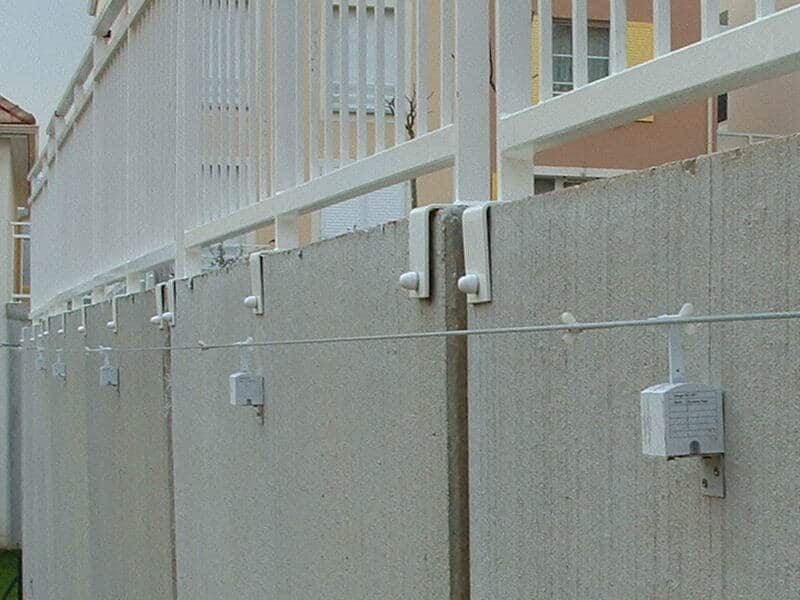
Example of a custom bracket mounting for monitoring the tilting of a retaining wall
G130 gauge mounted on a bracket to monitor the tilting of a retaining wall

Example of a mounting for monitoring the deflection of a beam
Mounting and tensioning of the G130 device on a beam

Two mounting methods are possible for the G3 gauge:

  • By bonding: fixing is quick and simple thanks to the double-sided self-adhesive pads supplied.
    For the bond to be effective, the substrate must be smooth and clean. If necessary, and in particular if the surface is not completely flat and has irregularities, the bond can be reinforced with a fast-curing two-component epoxy adhesive. In this case, it is also possible to apply the epoxy adhesive directly to the gauge without using the self-adhesive pad.
  • By mechanical fixing: where the substrate is very uneven, or is crumbling with a risk of the gauge coming loose, we recommend using an intermediate plate. This plate is fixed mechanically to the substrate with impact anchors (supplied with the plate), and the gauge is then bonded to the plate. The plate becomes the mounting surface.

Reading the G130 gauge

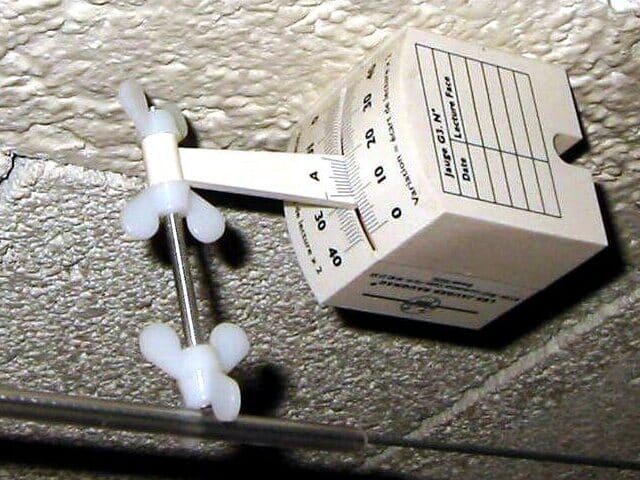
Readings are taken using a vernier scale to 1/10 mm. Note the letter of the face being read, A or B, so that readings are always compared against the same face over time.

The difference must be multiplied by 2 to obtain the evolution of the deflection to a tenth of a millimetre.

For a fuller explanation of how this works, refer to the G3 gauge instructions.

Recording kit

We offer an add-on recording kit that mounts on the G3 gauge. This kit records the maximum and minimum deformations of the structure graphically.

G130 gauge fitted with the G3 recording kit

More information on the G3 recording kit product page.

Digital monitoring with the app

Readings are recorded directly in the saugnac.app application, using the unique identifier printed on the gauge. Access to the app is free, on both PC and smartphone.

For a study and a tailored quotation: contact us.