



Deformation monitoring, the keystone of church preservation
Churches, chapels and cathedrals are an essential part of our architectural and spiritual heritage. Yet a large number of these buildings suffer from structural disorders linked to their age, ground movement, climatic conditions, or inadequate maintenance.
The progressive spreading of walls and the appearance of cracks are among the most concerning warning signs. They often indicate deep structural imbalances that must be monitored with precision to prevent irreversible damage.
Wall spreading: a recurring problem in churches

Many churches today suffer from progressive deterioration of their buttresses and flying buttresses, sometimes aggravated by architectural modifications or foundation disorders.
Buttresses — those masonry reinforcements visible on the exterior — are designed to contain the thrust exerted by the vaults. Flying buttresses complement this system by transferring these lateral forces to the buttresses, particularly at nave level.
Over time, ground movements (settlement, shrink-swell of clay soils), climatic stresses, vibrations, or the removal of load-bearing elements can weaken these components. Their effectiveness is reduced, allowing the walls to gradually drift apart — a phenomenon that accelerates the deterioration process.
Cracking, a phenomenon that requires precise monitoring
Cracking does not only affect abandoned churches: it can appear in old or more recent buildings, even those that have been well restored and maintained.
Vertical cracks are often observed at openings (doors, windows) or at the junction between the nave and the chancel. This may indicate abnormal wall movement caused by vault and roof structure thrust, or differential settlement of the foundations.
Vaults can crack longitudinally, particularly along the groins, due to the lateral thrust they exert on the side walls.
Vertical cracks on facades or tilting piers may result from foundation movements or uneven load distribution.
Finally, certain specific disorders, such as localised shear failures (diagonal cracks for example), may indicate complex stresses caused by combined movements of the structure and the ground.
The exact cause must of course be determined through a local structural survey, as not all cracks necessarily indicate a major structural problem — other reasons and factors may contribute to their formation.
Example of a monitoring installation in a cathedral in Marseille

As part of the structural monitoring of La Major Cathedral in Marseille, a G20 mechanical extensometer was installed to monitor the spreading of two walls.
This simple yet precise device enables very fine manual monitoring of deformation development, with a resolution of one tenth of a millimetre. Thanks to its graphite lead system, the gauge directly records the extreme values reached (minimum and maximum opening), making it possible to document the most significant movement phases over time.
This method provides essential data for assessing structural behaviour and making decisions regarding any necessary conservation interventions.
The new version of the G20 is more compact and easier to install. Installation example by Vivian & Cie:
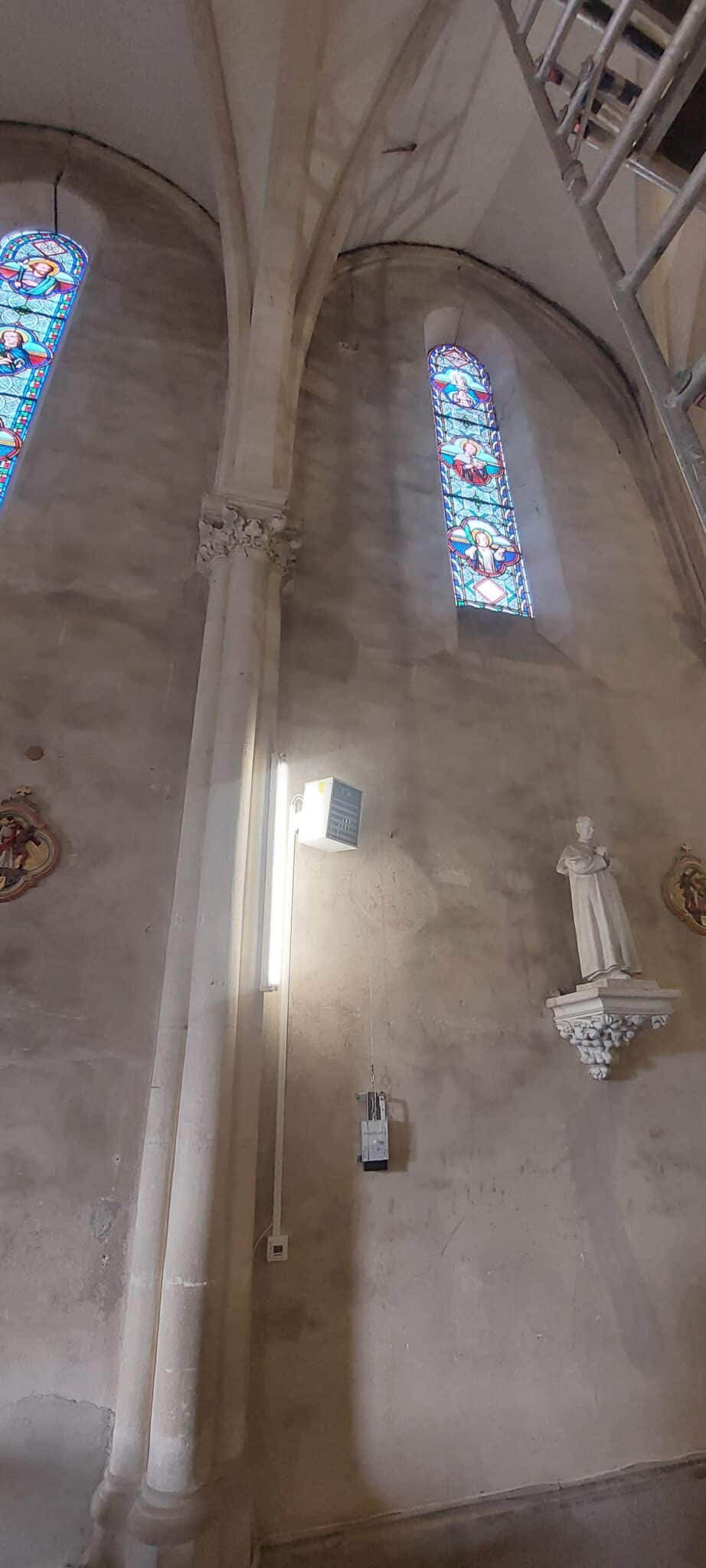
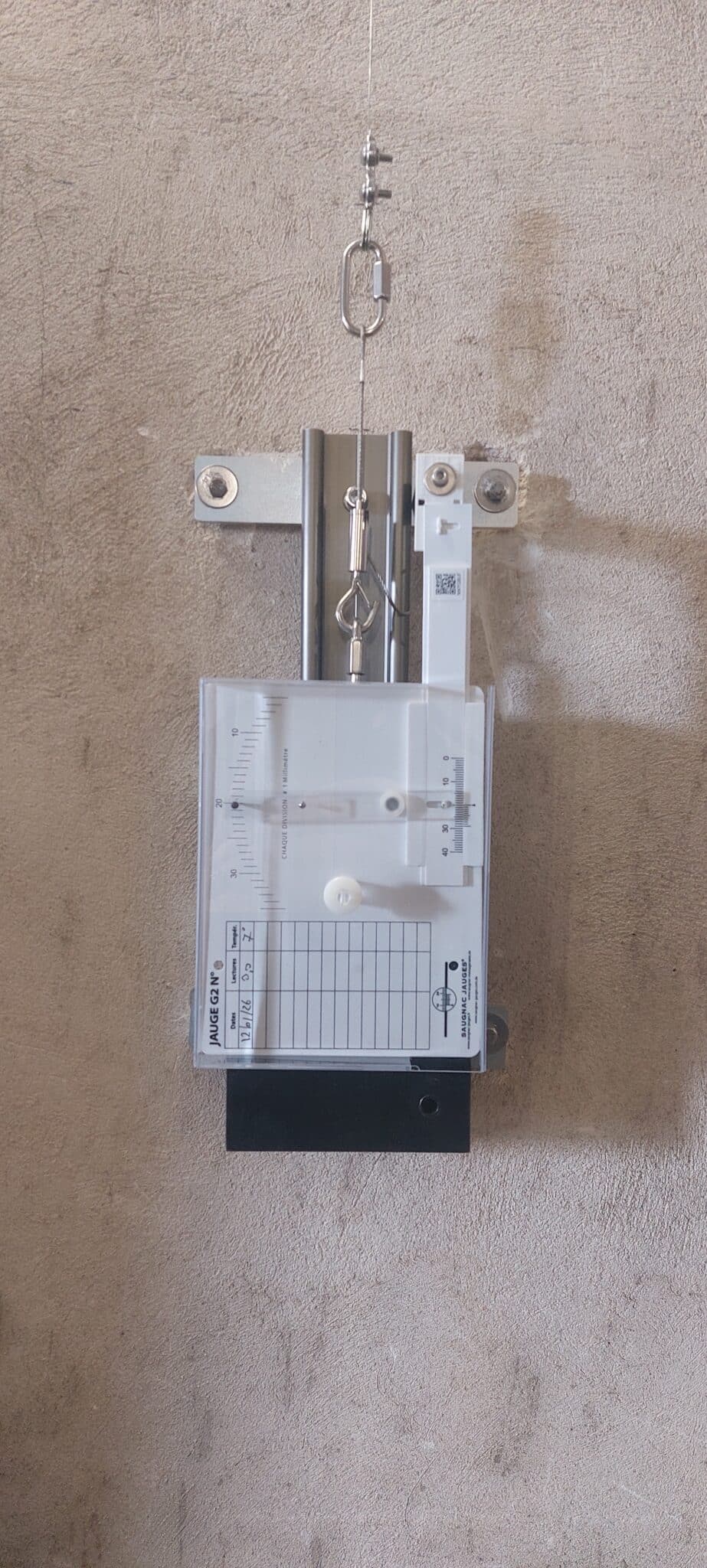
And this mechanical version is also available as a connected version: R20 extensometer
Monitoring wall spreading and cracks in a church: Saugnac Gauges instruments
Saugnac Gauges offers a comprehensive range of instruments for monitoring crack opening, its variations and other deformations with the highest precision.
The R1 connected gauge for hard-to-reach cracks
In buildings such as churches, access to cracks is often a challenge, particularly when they appear beneath vaults or on high walls. How can regular and safe measurements be taken on a crack that has appeared several dozen metres above ground?
For these difficult configurations, Saugnac Gauges has developed the R1 connected crackmeter, ensuring remote monitoring of crack opening, as well as temperature and humidity measured by sensors.
Examples of R1 crackmeter installations indoors and outdoors by EGSOL


These measurements can be taken at customisable frequencies and sent on a daily or weekly basis depending on the site’s monitoring requirements. All these parameters can be easily adjusted from the Saugnac app.
Extensometers for monitoring wall spreading

To monitor the progressive spreading of walls, extensometers, also known as convergence meters, are essential tools.
The G20 mechanical extensometer monitors the separation between two parallel walls, as well as between two points on the same wall, with the ability to record minimum and maximum movement using a graphite lead.
The R20 connected extensometer operates on the same principle as the G20 model, but with the ability to monitor wall separation remotely, along with temperature and humidity levels.
This connected extensometer / convergence meter offers the same features as the R1 connected crackmeter: configuration in a few clicks, battery life up to 8 years, threshold management with alert notifications and remote parameter adjustment.
Combining gauges to monitor other types of damage
Given the various types of deformation observed in religious heritage buildings, it is possible to combine other measuring instruments from the Saugnac Gauges range:
- Monitoring of pier offset or misalignment: carried out with the G3 gauge or the R1 gauge combined with an offset monitoring kit.
- Monitoring of opening and shear in the same plane: use of the G6 gauge or the 2-axis remote monitoring kit for precise remote measurements.
- Tilt monitoring: Saugnac mechanical inclinometers (G5 family) or the connected inclinometer (R5) provide reliable measurement of tilt variations on sensitive structures.
Our experts are available to answer any specific questions or to assist you in analysing your particular cases. Do not hesitate to contact us for further information or personalised advice.