
Cracks in walls: causes, monitoring and when to act

A few explanations about cracks in buildings
Cracks are the most common manifestation of structural issues in buildings, affecting exterior and interior walls, facades, partitions, floors, coatings, tiles, slabs, and more.
BRE Digest 251 — Assessment of Damage in Low-Rise Buildings, the widely used British standard for crack classification — defines six categories of damage based on crack width and severity.
Category 0 covers hairline cracks below 0.1 mm, which are considered negligible and require no action.
Category 1 covers fine cracks up to 1 mm, treatable by normal decoration.
From Category 2 upwards (over 1 mm), cracks may require professional assessment and repair.
Cracks above 5 mm (Category 3 and above) are generally considered structural and should be evaluated by a qualified surveyor or structural engineer.
Causes of cracks in walls
Cracks in a building can have various causes, and identifying the source of the problem is essential for implementing appropriate repairs. Below are some of the most common causes of cracks in buildings:
Shrink-swell of clay soils
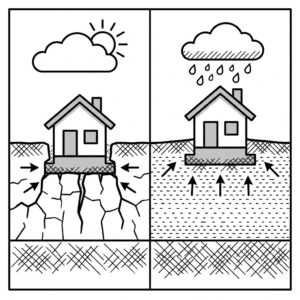 Clay soils contract and expand depending on their water content. During dry spells they shrink; when it rains they swell back. These repeated volumetric changes beneath foundations cause differential movements that result in cracks in walls and facades.
Climate change is making these cycles more extreme: severe droughts followed by heavy rainfall are increasing both the frequency and severity of shrink-swell damage.
A growing number of properties are now exposed to the effects of clay soil movement.
Tree roots and the turbosuction effect
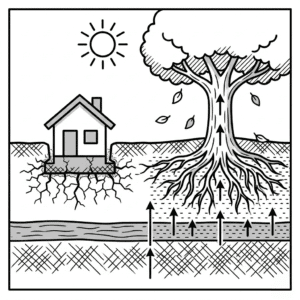 Trees and vegetation near foundations can significantly worsen clay soil movement. During dry periods, roots extract large volumes of water from the ground, intensifying soil shrinkage directly beneath the building.
This is compounded by what is known as the turbosuction effect: when a tree rapidly depletes soil moisture reserves, the dry zone around its roots acts like a vertical pump, drawing water up from deeper soil layers.
This mechanism causes faster and deeper ground drying than rainfall deficit alone.
These effects can:
- significantly worsen clay soil shrinkage by increasing the amplitude and depth of ground movement;
- trigger cracks even in soils with low clay content, simply because turbosuction suddenly disrupts the moisture balance around foundations.
More generally, any imbalance in water management around the building (turbosuction, poor drainage, concentrated runoff, inadequate slope) can create differential stress at foundation level. These issues often require vertical solutions: drainage wells, root barriers, targeted underpinning, improved drainage systems, and so on.
Soil Settlement or Subsidence
This phenomenon may be natural or triggered by human activities such as mining or construction work (e.g., foundation digging, drilling). Changes in soil structure caused by these activities can lead to ground subsidence, which may result in cracks in nearby buildings.
Foundation problems
Issues such as inadequate design, poor-quality construction materials, or improper construction methods can lead to foundation problems, which are often the source of cracks in walls. Defective foundations can cause subsidence, cracks, or deformations, placing stress on the building’s structure.
Vibrations and Ground Movements
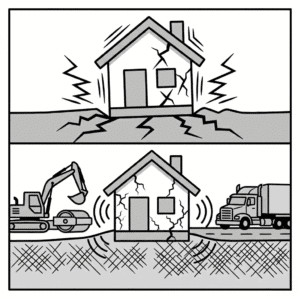 Cracks in buildings can also be triggered by factors like seismic vibrations, nearby human activities such as construction, or heavy road traffic.
Seismic vibrations from tectonic activity exert pressure on foundations, increasing the risk of cracks.
Similarly, construction and road traffic generate ground movements that, over time, can weaken structures.
Temperature variations
Temperature fluctuations, especially freeze-thaw cycles, are another cause of cracks in buildings. These thermal variations create stress on construction materials and foundations, leading to repeated expansion and contraction. Freezing is particularly damaging, exerting pressure on the structure when water infiltrates stones, bricks, or joints. Frozen soil can also cause heaving movements, destabilising buildings and causing cracks — particularly in clay soils.
Construction Defects
Cracks can also result from construction defects caused by errors during design or execution. Poorly executed joints, insufficient structural reinforcement, or defects in materials can compromise the building’s stability. Improper joints allow water infiltration, leading to degradation and cracks.
It is important to call in construction/building experts to assess the cause of cracks and determine the best approach to repairing them sustainably. In some cases, foundation repair, drainage or waterproofing work may be required to resolve the problem at source.
Cracking is a complex subject, with so many causes that it is important to diagnose the origin before carrying out effective repairs.
Why monitor cracks in walls — and how to do it?
A phenomenon can only be properly analyzed if it can be quantified. By measuring crack width over time, it becomes possible to determine whether the crack is still active and take appropriate action.
We offer a comprehensive range of tools to monitor cracks in walls. You can find detailed guidance in our technical datasheet to help you choose the appropriate crack monitor based on the crack or movement to be measured.
How long should you monitor a crack in a wall?
There is no single rule, because the answer depends on the context and the cause of the disorder. In general, it is advisable to take measurements very regularly at the beginning and gradually space them out if no movement is observed.
For cracks related to soil movements, it is typically recommended to leave crack monitors in place for one year to assess whether seasonal changes affect crack movement. A minimum of four readings per year is recommended, although more frequent readings may be necessary if significant variations are observed.
For specific cases or uncertainties, consulting a building expert is advisable to refine and adapt the monitoring schedule based on the context.
Active vs dormant cracks: how to tell the difference
A dormant crack (one that is no longer active) is defined as a crack in a building wall whose width does not change over time, regardless of temperature or structural stress.
For cracks caused by soil movements, the minimum duration to consider a crack dormant is one year. As a general rule, a crack with movement exceeding 0.3 to 0.5 mm is not yet considered dormant.
For interpreting your measurements, we recommend consulting a building expert who can identify the cause of the damage, assess whether it is active, and suggest appropriate solutions if needed.