


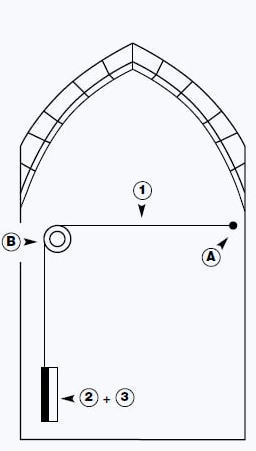
 The G20 extensometer measures the change in separation between 2 points (labelled A and B) at a distance D metres apart.


You want information for
G20 gauge – Extensometer
If you would like a quotation or have any questions about the product, please contact us:
- by email at info@saugnac-gauges.com
- by telephone on +33 9 62 07 18 68




Technical specifications
|
Overview of the G20 gaugeThe G20 gauge is a mechanical extensometer designed to monitor the separation between 2 points several metres apart with a resolution of 0.1 mm. The two points may be located several metres above the ground. The reading is taken at ground level. Example of installation by Vivian & Cie:
What is an extensometer used for?The extensometer gauge, also known as a convergence meter, is a measuring instrument recommended for assessing wall separation, the distance between two points several metres apart, or the lateral thrust of structures. How is the extensometer gauge installed?The Invar cable is cut to the required length depending on the installation context and can be adjusted by ±15 cm at the time of installation. This Invar cable is fixed on one side to the wall and on the other side to the counterweight of the G20 gauge. A ball-bearing pulley is fixed to the opposite wall, directly facing the first fixing point. G20 extensometer: operating principle and advantagesThe main advantages of the G20 gauge are: accuracy, simplicity and reliability of measurements. Accuracy of the extensometer measurementThe G20 extensometer gauge has a resolution of 0.1 mm for instantaneous readings. Convenience of ground-level readingGround-level reading ensures simplified monitoring of separations and eliminates the constraints associated with implementing secure access at height. Simplicity of monitoringMonitoring is very straightforward: the vernier scale is read (resolution 0.1 mm), and minimum and maximum values are recorded with a resolution of 0.5 mm. System reliabilityThe Invar cables eliminate thermal expansion effects. Furthermore, a counterweight system maintains constant tension, allowing the extensometer to measure only the separation without being influenced by other mechanical phenomena. Equipment protectionThe optional lockable enclosure protects the instrument without obstructing the reading, thanks to its transparent cover. Traceability in the Saugnac appWith gauge identification by QR code, measurement monitoring is carried out via the Saugnac application. No maintenance requiredThe robust mechanical system of the extensometer gauge ensures optimum durability with no maintenance.
|
Monitoring the separation between 2 points
Point (A) is a ring with a fixing bracket. Point (B) is a ball-bearing fixed to a bracket that redirects the Invar wire vertically down to the monitoring station. An Invar cable (1) is fixed on one side to point (A) and on the other side to the counterweight of the station (2). Between its two ends, the Invar wire runs over the ball-bearing pulley (B), fixed to the wall directly above the station. The counterweight system maintains constant tension throughout, ensuring that the gauge measures only the separation between points (A) and (B). The extensometer is fixed at head height, allowing readings to be taken at ground level. An optional enclosure (3) secures the gauge when required. The gauge is fixed to a counterweight which itself slides along a guide rail. The movable arm of the gauge is bonded to the housing, which is rigidly fixed to the wall. Any variation between point A and B therefore causes the counterweight to move, and consequently the movable arm of the extensometer gauge. |
Monitoring the separation between 2 points in the same plane
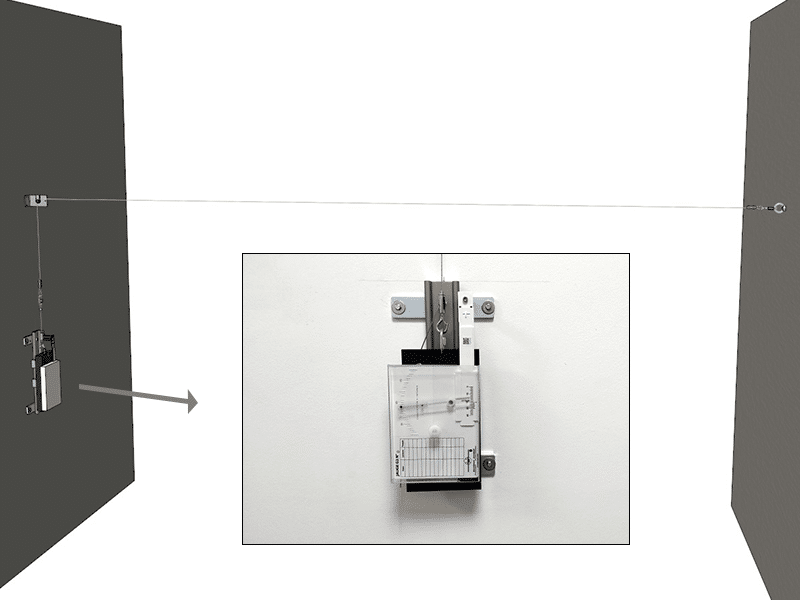
For example, it can be used to monitor the separation between two points on a wall, even if they are several metres apart. In this configuration, a specific optional screw kit is supplied to ensure appropriate installation on a single plane.
|
Protective enclosure
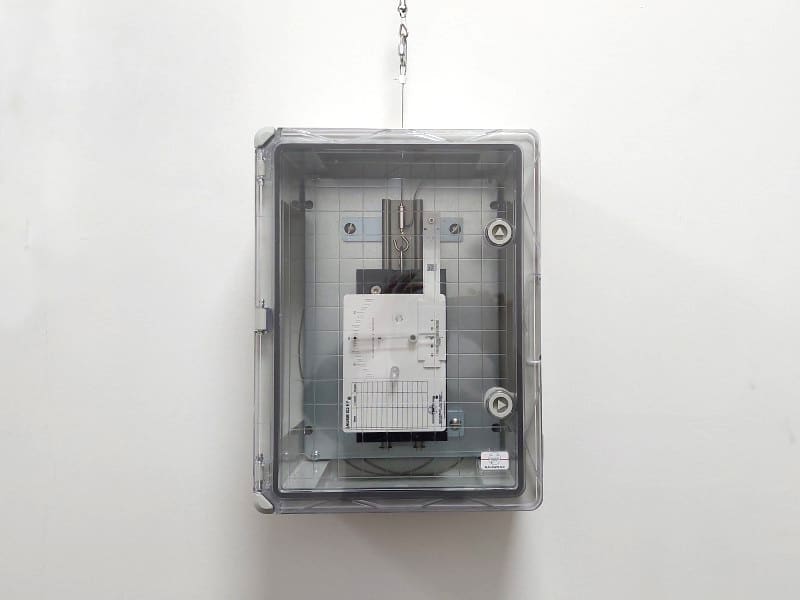
A key is supplied for secure locking. As the cover is transparent, the extensometer can be read without having to open the enclosure lid. |
Extensometer min/max recording: operating principle
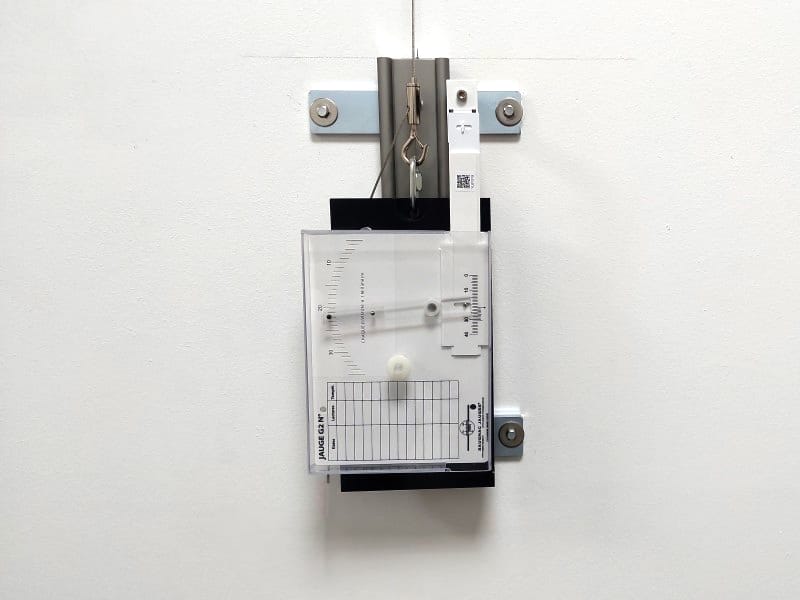
As the movable arm travels, it drives a carrier arm fitted with a graphite lead at its tip, held under pressure by a polycarbonate leaf spring. The lead trace corresponds to three times the displacement of the vernier. It produces a line marking the evolution of the measured phenomenon, making it easy to visually identify the maximum and minimum values. The scale is graduated in millimetres. The minimum and maximum readings can be taken with a resolution of 0.5 mm. |
Measurement monitoring with the Saugnac appThe Saugnac web application, completely free and without any limitations, is accessible on both PC and smartphone via https://saugnac.app/.
All accessible from any compatible PC or smartphone |