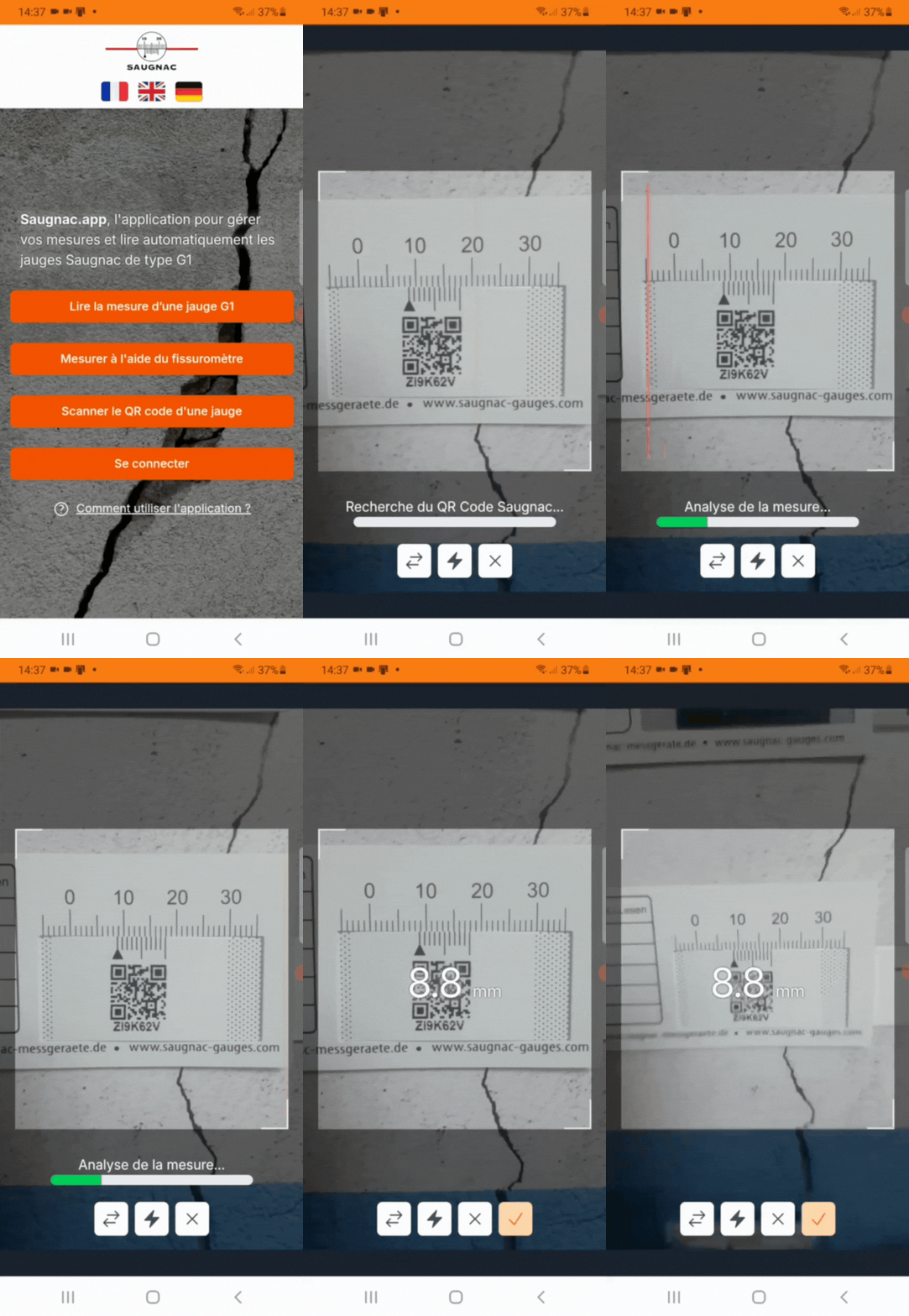
 To make reading easier, you can also use the

You want information for
G1 Gauge
If you would like a quotation or have any questions about the product, please contact us:
- by email at info@saugnac-gauges.com
- by telephone on +33 9 62 07 18 68




Technical specifications
| ||||
How to install the G1 crack monitor?Two mounting methods are available:
| ||||
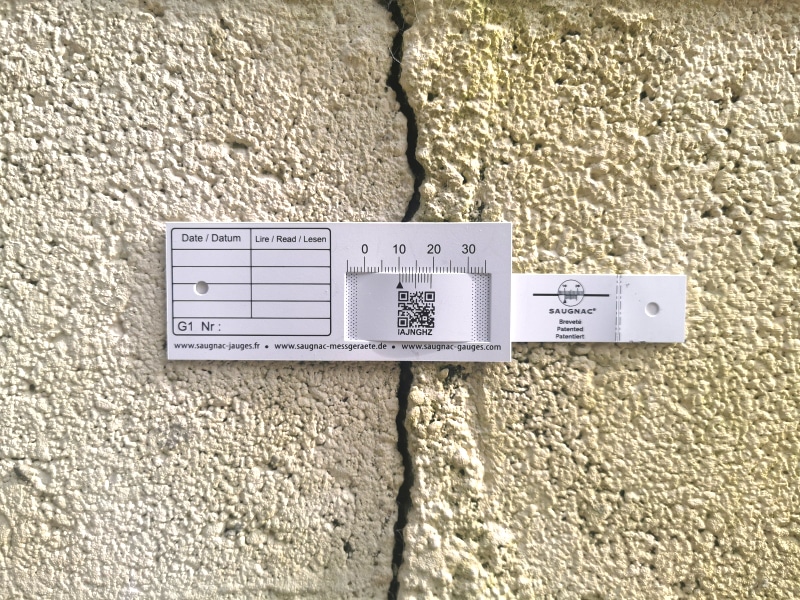
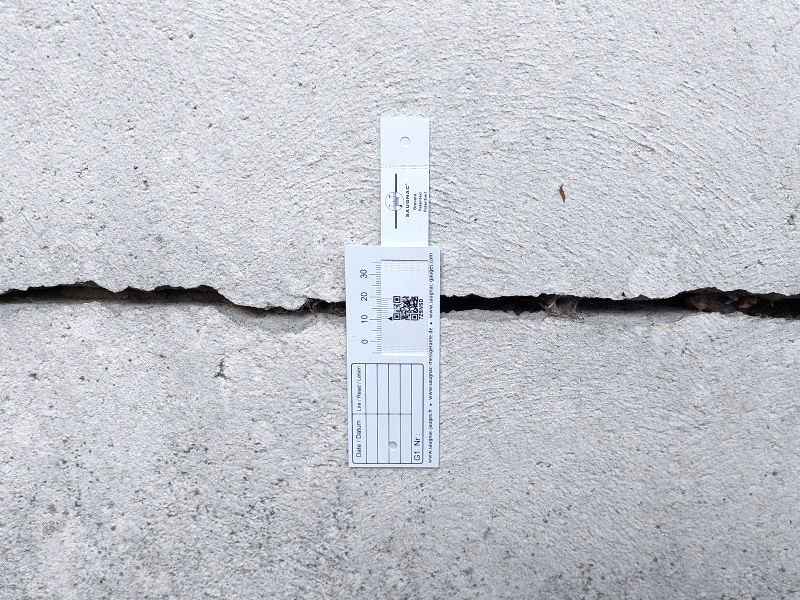
Installation tipsTo measure crack movement as effectively as possible, the gauge is usually fixed where the crack is widest (often in the middle of the crack). The gauge can be fixed whatever the direction of the crack (vertical, horizontal, diagonal), straddling the crack, to measure changes in its width. The G1 gauge is made of a material flexible enough to adapt to irregular, convex or concave surfaces.
Ideally, position the vernier triangle between 10 and 11, with the 2 speckled bands visible on the left and right. The aim is to centre the sliding arm. Do not try to position the vernier triangle If the crack is narrow and you want to maximise the opening travel, you can position the vernier closer to zero. Note: the G1 gauge does not measure movement along the Y axis (sliding along the crack). For this, use a G6 gauge, which measures movement on 2 axes in the plane. | ||||
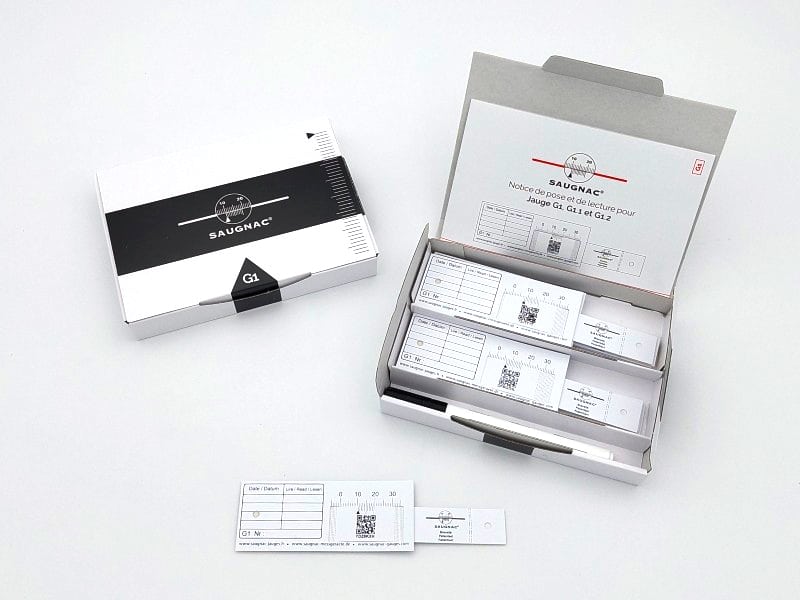
How to measure a corner crack?New versions of the G1 gauge (from mid-2025) are manufactured with a groove marking a fold line on the sliding arm. This groove makes it easy to fold the sliding arm for corner mounting without any additional accessory.
Earlier versions of G1-family gauges were supplied with a foldable strip for corner mounting. This part has a thin section designed to guide and ease folding. An aluminium angle bar (sold separately) can also be used.
| ||||
How to protect the G1 crack monitor?
To protect the gauge, we offer a UV-resistant protective cover. The cover is fixed with the wall plugs and screws supplied with it. In high-traffic areas where the risk of damage is high, the removable E1 gauge with transparent platines can be used instead. After each reading, only the platines remain on the surface, which prevents any damage. | ||||
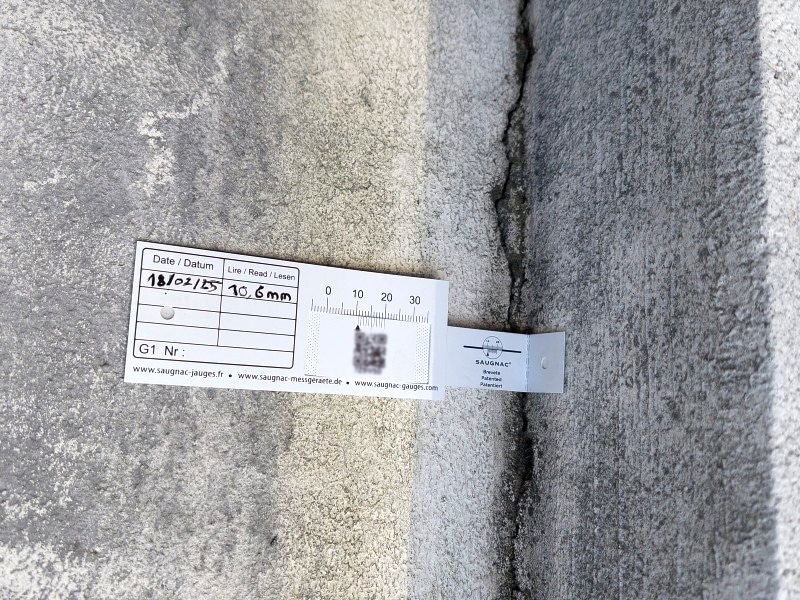
How to read the G1 crack monitor to 0.1 mm?The upper scale is graduated in mm from 0 to 30: this is the main scale. The lower scale is movable: this is the vernier, reading to 0.1 mm (10 vernier divisions correspond to 9 mm on the main scale).
Taking a readinga) Reading the millimetres: The vernier pointer  b) Reading the decimal: Find the vernier line that lines up exactly with a line on the main scale. In the example, vernier graduation 8 lines up with graduation 21 on the main scale: the decimal is therefore 8/10 mm. The reading is therefore 13.8 mm. The first reading is only a reference and has no value in itself. Comparing this initial reading with the subsequent readings is what shows and quantifies the movement. For even easier reading or a finer resolution: the G1+ gauge with direct reading or the E1 gauge with digital reading.
The application can also give the reading corrected for thermal expansion when you enter the temperature at the time of the reading. As a guide, the effect is approx. 9 µm per degree. | ||||
Download the Saugnac.app application to track your readings The Saugnac web application, completely free and unlimited, is available on PC or smartphone at https://saugnac.app. It lets you:
Find all the explanations on how the application works. | ||||
Download the Excel monitoring file
This Excel file is very easy to use: simply duplicate a sheet for each site or project monitored, with each sheet tracking up to 10 gauges. Note: the effect of thermal expansion on G1 readings is small (approx. 9 µm per degree). | ||||
Frequently asked questions about the G1 crack monitorWhat is the G1 gauge used for?The G1 gauge is a vernier crack monitor, also known as a crack gauge, that measures changes in crack width to 0.1 mm. Fixed across the crack, it shows whether the crack is opening, closing or stable, and quantifies that movement through successive readings. What is the difference between the G1 gauge and a plaster crack monitor?A plaster crack monitor (a plaster patch bridging the crack) only shows that movement has occurred: it cracks or comes loose, without indicating the size or direction of the movement. The G1 gauge gives a numerical value at each reading, for both opening and closing, over a range of approx. 20 mm. For a detailed comparison, see our sheet the G1 crack monitor, an alternative to plaster crack monitors. What is a tell-tale crack monitor, and how does it compare with the G1 gauge?A tell-tale crack monitor is made of two overlapping plates, a graduated one and a transparent one with a cross-hair, fixed on either side of the crack; the reading is taken where the cross-hair sits on the printed grid. The G1 gauge is a one-piece gauge with a sliding arm and a vernier, read to 0.1 mm. The two devices are compared point by point in our sheet tell-tale vs vernier crack monitors. How do I know if a crack is still moving?By comparing each reading with the first one, which serves as the reference (see how to read the G1 crack monitor). A crack whose width remains stable from one reading to the next is considered stabilised; a change that continues or increases indicates an active crack. Interpreting the readings and making a diagnosis is a matter for a professional (structural engineer, surveyor). How often should the gauge be read, and for how long?There is no absolute rule: the reading frequency should be agreed with the professional monitoring the building, depending on the context and the level of risk. Some cracks open and close with the seasons, particularly during droughts and with clay shrinkage and swelling. To observe these variations, one reading per season is a bare minimum. More frequent readings, for example monthly, give a more detailed picture of the movement and allow earlier action. Does temperature need to be taken into account?The gauge expands slightly with temperature: approx. 9 µm per degree, i.e. less than 0.1 mm for a 10 °C difference. The effect is therefore small compared with the gauge’s resolution, but the Saugnac application and the Excel file can correct each reading if you note the temperature at the time of the reading. Does the G1 gauge measure sliding along the crack?No: the G1 gauge measures movement on a single axis, perpendicular to the crack (opening and closing). To also monitor sliding along the crack, use the G6 gauge, which measures movement on 2 axes in the plane. Can the G1 gauge be installed outdoors?Yes. The gauge is made of PVC with a UV stabiliser, and the adhesive strips supplied remain effective from -40 °C to +90 °C. On crumbly, dusty or damp surfaces, screw fixing is preferable. In high-traffic areas, a protective cover reduces the risk of damage. Can the G1 gauge be read with a smartphone?Yes, for gauges with a QR code: the free Saugnac application automatically reads the measurement with the smartphone camera and saves it in your monitoring account. What should I do if the crack exceeds the gauge’s range?The measuring range of the G1 gauge is approx. 20 mm. If the vernier approaches its end stop, install a new gauge and continue monitoring using its first reading as the new reference, while keeping the history of the first gauge. |

UV-resistant protection for G1-type gauges installed outdoors. Supplied with fixing hardware.

Fast-curing epoxy adhesive in a twin-syringe for reinforced bonding in cases of significant surface roughness or high moisture

Mechanical fixing kit for surfaces unsuitable for self-adhesive installation (includes 1 drill bit + 1 PZ1/PZ2 screwdriver + 40 wall plugs and screws)

Bag of 50 anchors and screws for mechanical fixing on surfaces unsuitable for self-adhesive mounting

For measuring the variation in a crack in a vertical or horizontal internal angle (with self-adhesive tabs and 1 impact anchor).