
Crack monitoring on historic buildings: how can heritage be protected?
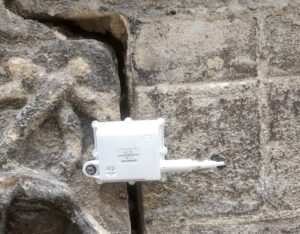
On a protected building – listed, scheduled or classified as a historic monument – crack monitoring takes place within a technical and regulatory framework that can rule out some common solutions, such as scaffolding.
What specific constraints apply to heritage buildings, and which crack monitoring methods are compatible with them?
Historic buildings and cracks: the constraints of protected heritage
Heritage protection places legal restrictions on what can be done to a building. In France, the protection of historic monuments is a public-interest easement (servitude d’utilité publique) attached to the property.
Levels of protection
In France, a building can be “inscrit” (registered) or “classé” (classified) as a historic monument. Registration recognises a building’s historic or artistic interest, while classification is reserved for buildings whose preservation is in the public interest.
Works on a classified building may only be carried out with prior authorisation from the regional prefect, following review by the regional curator of historic monuments (CRMH) and the Architecte des Bâtiments de France (ABF), the state heritage architect. This oversight covers the whole project, from the technical study phase through to final acceptance of the works, in accordance with articles R.621-11 to R.621-14 of the French Heritage Code.
The surroundings of these monuments may also be covered by a protection perimeter, within which works are subject to prior approval by the ABF.
In the United Kingdom, the equivalent system is based on listed buildings (Grade I, II* and II in England and Wales; categories A, B and C in Scotland) and scheduled monuments. Any works affecting the character of a listed building require Listed Building Consent from the local planning authority, and carrying out such works without consent is a criminal offence. Works to a scheduled monument require Scheduled Monument Consent, administered in England by Historic England. Conservation areas add a further layer of control.
In the United States, listing on the National Register of Historic Places does not in itself restrict private owners: constraints generally come from local historic preservation ordinances and, for projects involving federal funding or permits, from the Section 106 review process. The Secretary of the Interior’s Standards for the Treatment of Historic Properties also favour reversible, minimally invasive interventions.
Implications for crack monitoring
If a historic building requires crack monitoring, several constraints should be anticipated:
- restricted access: scaffolding prohibited outside authorised areas, site safety requirements, etc.;
- fixing constraints due to the age or fragility of the substrate (dressed stone, lime mortars, original renders);
- preference for monitoring devices with a low visual impact.
The installation of monitoring instruments must be assessed case by case, in consultation with the heritage architect or project manager and, where applicable, the relevant authorities: in France, the UDAP (departmental architecture and heritage units) or the DRAC (regional directorate of cultural affairs); in the UK, the local authority conservation officer or the national heritage body (Historic England, Historic Environment Scotland, Cadw). If the installation is fully reversible, discreet and non-destructive, simple prior notification – or, in the UK, confirmation from the conservation officer that no consent is needed – may be sufficient.
However, where the installation involves drilling, visible fixings or a permanent device on a protected element, authorisation may be required under the French Heritage Code (articles L621-9 et seq.) or, in the UK, Listed Building Consent.
In all cases, it is advisable to involve the heritage architect responsible for the building from the study phase onwards, in order to validate the method and the compatibility of the instruments.
How can cracks be monitored on a protected building while respecting these constraints?
Many historic monuments present physical constraints: considerable heights, carved façades, fragile materials or inaccessible areas.
These conditions call for lightweight, discreet and easily removable solutions, capable of monitoring cracks without damaging the substrate – and without scaffolding where it is not permitted.
To find the right solution, start by reviewing the available information:
- photographic survey and crack mapping;
- identification of the type of crack (shrinkage, settlement, differential movement, thermal movement);
- assessment of the substrate (stone, masonry, render, metal).
This information makes it possible to define a measurement protocol suited to the nature of the defect and to the heritage sensitivity of the building.
Which crack monitoring solutions can be used on a historic building?
With accurate and discreet instruments, professionals can track how a defect develops without compromising the heritage integrity of the building.
Adhesive fixing
Fixing methods must preserve facings weakened by time, as well as sensitive substrates such as porous limestone or lime mortars.
Where any drilling is prohibited – even of small diameter, such as the 4 mm holes needed to fix mechanical crack monitors – bonding becomes the ideal alternative. On a sound substrate, this simply means using the self-adhesive pads supplied with the mechanical gauges.
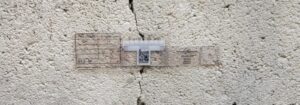 Transparent crack monitors, such as the Saugnac G1.2 gauge, are highly discreet while still providing an accurate reading of crack movement.

Remote monitoring for hard-to-reach areas
When the crack is located in a hard-to-reach area, remote monitoring provides regular readings without the need for heavy access equipment such as scaffolding.
Wireless crackmeters such as the R1 gauge transmit readings to an online monitoring platform, which also makes it easier for the different professionals working on the same building to share data.
The reading method and frequency depend on the type of crack. Monthly readings may be enough for a stabilised crack, whereas an actively developing crack calls for more frequent monitoring. Automatic readings make it easier to build an accurate picture of changes in crack width and to identify the trend (stabilising, worsening or seasonal cycle).
Regulatory compliance: authorisations and coordination
Crack monitoring on a historic monument is a scientific and technical process, but also an administrative and regulatory one.
Prior authorisation for protected buildings
In France, according to the Ministry of Culture, no modification, restoration or installation work may be carried out on a classified building without prior authorisation from the regional prefect.
This authorisation is required even for one-off technical interventions, as soon as they alter the structure or appearance of the building.
Studies and works are subject to the scientific and technical oversight of the DRAC, which supports the project from diagnosis through to completion.
The same logic applies in the UK: any intervention affecting the special interest of a listed building requires Listed Building Consent, and early discussion with the conservation officer is the most reliable way to secure approval for a monitoring installation.
Need help choosing a discreet monitoring solution for a heritage building? Contact us at info@saugnac-gauges.com.